

A business website does not have to be completely broken before it needs attention.
In many cases, websites continue working for years while gradually becoming slower, harder to maintain, less effective on mobile devices, and increasingly disconnected from the business they are supposed to represent.
That is where a website redesign becomes valuable.
A good redesign is not simply about changing colors, replacing images, or making a homepage look more modern. It is an opportunity to improve how the website communicates, performs, supports visitors, appears across devices, and fits into the broader goals of the business.
The question is: how do you know when it is time to redesign your website instead of continuing to make small fixes?
Here are some of the most common signs.
1. Your Website Looks Outdated
Visual design is not everything, but it strongly influences a visitor's first impression.
A website may begin to feel outdated when it relies on old layout patterns, crowded pages, inconsistent typography, dated graphics, excessive visual effects, or design elements that no longer reflect the company's brand.
This does not mean businesses need to redesign their websites every time a new design trend appears. Trends change constantly, and chasing them can create just as many problems as ignoring design altogether.
The more important question is whether the website still feels credible, intentional, and appropriate for the business.
A modern redesign can improve elements such as:
- Typography and readability
- Page spacing and visual hierarchy
- Navigation
- Color consistency
- Images and graphics
- Calls to action
- Content presentation
- Overall brand consistency
The objective should not simply be to make the website "look newer." The design should make the website easier to understand and use.

2. The Website Is Difficult to Use on Mobile Devices
Mobile usability should be considered a basic requirement for a modern business website.
A site might technically be responsive while still providing a poor mobile experience.
Common problems include text that is difficult to read, navigation that feels awkward, buttons that are too small, oversized images, horizontal scrolling, forms that are frustrating to complete, and layouts that were clearly designed primarily for desktop screens.
A redesign provides an opportunity to reconsider the experience from a responsive perspective rather than simply shrinking the desktop design.
Important information should remain easy to find regardless of whether someone visits from a desktop computer, tablet, or phone.
The goal is not to make every device look identical. It is to provide a consistent and usable experience across different screen sizes.
3. Your Website Has Become Too Slow
Website performance often becomes worse gradually.
New plugins are installed. Larger images are uploaded. Tracking scripts are added. Templates accumulate additional CSS and JavaScript. Third-party integrations increase. Old components remain even when they are no longer necessary.
Eventually, the website becomes heavier than it needs to be.
Performance problems can affect both usability and the overall quality of the visitor experience. A redesign or technical rebuild creates an opportunity to examine the website more systematically.
That can include reviewing:
- Image sizes and formats
- CSS and JavaScript
- Extensions and plugins
- Fonts
- Caching
- Third-party scripts
- Hosting configuration
- Template structure
- Core Web Vitals
- Mobile performance
A redesign should therefore consider performance from the beginning rather than treating optimization as something to worry about after the new website has already been built.
4. Visitors Struggle to Find Important Information
Sometimes the biggest website problem has nothing to do with visual design.
It is the structure.
Businesses evolve over time. New services are added, old pages remain online, navigation grows, and content gets placed wherever there happens to be room.
Eventually, visitors may have difficulty understanding what the company offers or where they should go next.
This is an information architecture problem.
A redesign provides an opportunity to review the website from the visitor's perspective.
Ask questions such as:
What information are people looking for?
Which pages matter most?
Are services clearly organized?
Can visitors understand the business quickly?
Are calls to action obvious without being intrusive?
Does each page have a clear purpose?
Improving navigation and content structure can sometimes have a greater impact than changing the visual design itself.
5. Your Website No Longer Represents Your Business
Businesses change faster than websites sometimes do.
A company may introduce new services, enter new markets, change its positioning, update its branding, or begin serving a different type of customer.
Meanwhile, the website continues presenting the business as it existed several years ago.
This creates a disconnect.
A prospective customer should not have to contact the company just to discover that half of the information on the website is outdated.
A redesign is a good opportunity to align the website with the current business.
That may include updating:
- Brand messaging
- Services
- Team information
- Portfolio or case studies
- Testimonials
- Calls to action
- Photography
- Visual identity
- Contact information
- Customer journeys
Your website should represent the business you operate today, not the version of the business that existed when the site was originally launched.
6. Updating the Website Has Become Difficult
A website can look perfectly acceptable from the outside while becoming increasingly difficult to manage behind the scenes.
This happens frequently with older websites.
Templates may have been heavily modified. Plugins or extensions may no longer be supported. Content can become buried inside complicated page builders. Different developers may have added code using different approaches.
Eventually, even simple updates become unnecessarily difficult.
That creates technical debt.
For websites built with content management systems such as Joomla or WordPress, a redesign can be an opportunity to simplify the environment.
The goal should be to make future maintenance easier, not simply produce a good-looking website on launch day.
A well-planned website should be understandable and maintainable after the redesign is complete.
7. Your Website Has SEO Problems
A website redesign can have significant implications for search visibility, which is why SEO should be considered during the project rather than after launch.
Problems may exist in areas such as:
- Page titles and metadata
- Heading structure
- Internal linking
- URL structure
- Duplicate or outdated pages
- Thin content
- Mobile usability
- Website performance
- Crawlability
- Broken links
- Redirects
A redesign is an opportunity to improve these foundations.
However, redesigning a website does not automatically improve search rankings. Poorly handled redesigns can also create SEO problems, particularly when valuable pages are removed or URLs are changed without appropriate planning.
Existing search performance should therefore be reviewed before major structural changes are made.
SEO should be part of the redesign process, not an afterthought.
8. Your Website Gets Visitors but Few Inquiries
Traffic alone does not make a website effective.
A business website should help visitors understand what the company offers and what they can do next.
If people arrive but rarely contact the business, request information, schedule a consultation, make a purchase, or complete another meaningful action, the website deserves closer examination.
The problem may involve the offer, content, traffic quality, or other factors outside the website itself. But the website experience should also be reviewed.
Look at areas such as:
- Calls to action
- Service descriptions
- Contact forms
- Trust signals
- Page hierarchy
- Navigation
- Mobile usability
- Content clarity
- Customer journey
A redesign cannot guarantee more leads or sales, but it can remove unnecessary friction and create clearer paths toward important actions.
9. Security and Maintenance Are Becoming More Difficult
Older websites often accumulate components that become increasingly difficult to maintain.
Plugins, extensions, templates, themes, and integrations may stop receiving updates. Older software may also become incompatible with newer server environments.
This can turn routine maintenance into a recurring problem.
Website security is not achieved by redesigning the interface, but a redesign or rebuild can provide an opportunity to review the technical environment.
That may include evaluating user accounts, extensions, backups, SSL and HTTPS configuration, forms, outdated components, and general maintenance practices.
Security should be treated as part of ongoing website health rather than something that is addressed only after an incident occurs.
10. You Spend More Time Fixing the Website Than Improving It
Every website requires maintenance.
But there is a difference between maintaining a healthy website and repeatedly repairing an aging one.
If every update creates another compatibility problem, simple content changes require developer intervention, extensions constantly conflict, or the template prevents meaningful improvements, continuing to patch the existing site may eventually become inefficient.
At that point, the question changes.
Instead of asking:
"How do we fix this problem?"
it may be more useful to ask:
"Would rebuilding this properly create a better foundation?"
That does not automatically mean starting over.
Sometimes the best solution is still an incremental redesign. Other situations justify replacing the underlying template, reorganizing the content structure, or rebuilding much of the website.
The decision should depend on the condition of the existing site and the goals of the business.

Website Redesign vs. Website Rebuild: What's the Difference?
The terms are often used interchangeably, but they do not always mean the same thing.
A website redesign usually focuses on improving the presentation and user experience of an existing website. The CMS and much of the underlying infrastructure may remain in place.
A website rebuild involves deeper technical changes.
This might include replacing the template, restructuring the website, changing how components work, cleaning up extensions, rebuilding pages, or moving to a different platform.
For example, an existing Joomla website with a healthy content structure may only need a modern custom template and improved page layouts.
Another website may be running an outdated CMS, unsupported extensions, years of accumulated code, and a structure that no longer matches the business. In that situation, a deeper rebuild may be more practical.
The right approach depends on what is worth keeping.
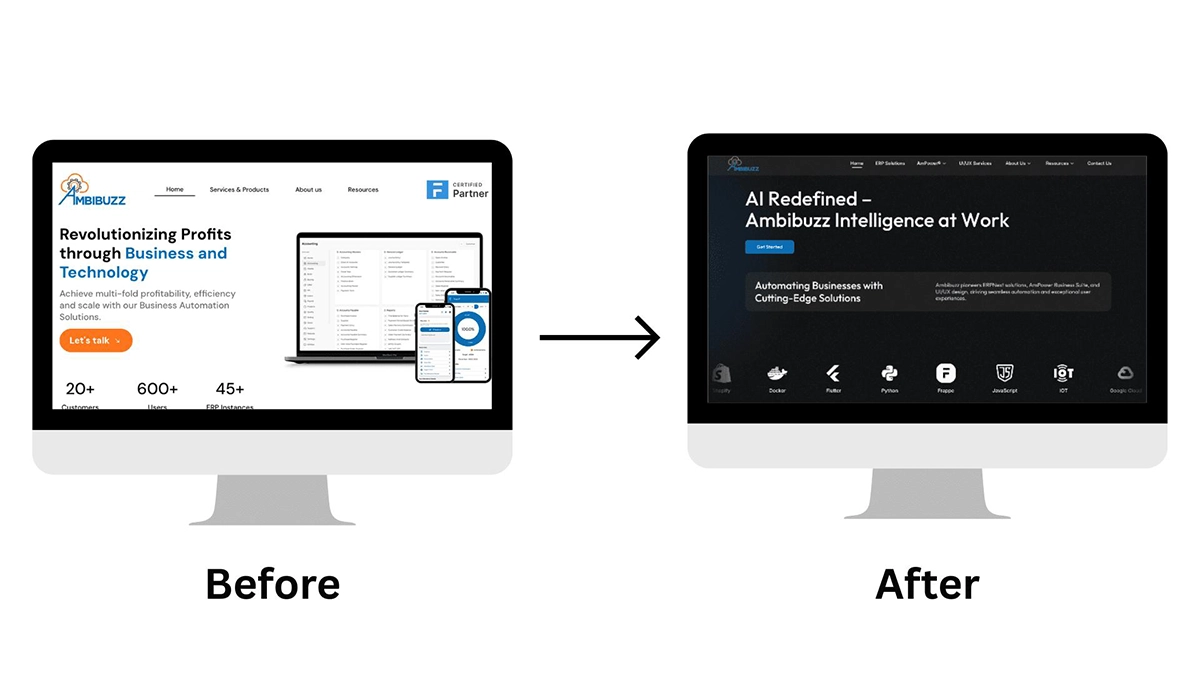
What Should a Modern Website Redesign Improve?
A successful redesign should improve more than appearance.
I generally think about a website as several connected systems.
Design determines how information is presented.
User experience determines how easily people can navigate and interact with it.
Content explains what the business offers.
Performance affects how efficiently the experience is delivered.
SEO foundations help search engines understand and access the website.
Security and maintenance influence how reliably the site can be managed over time.
Analytics provide information about what happens after launch.
When these areas are considered together, the result is more than a new visual design. It becomes a stronger digital foundation for the business.
How I Approach a Website Redesign
I prefer to begin with the existing website rather than immediately designing a replacement.
There may already be valuable content, pages, search visibility, functionality, branding elements, or technical components worth preserving.
My general process follows eight stages.
Discover — Understand the business, audience, website goals, and current challenges.
Audit — Review the existing structure, content, design, performance, technical condition, and other relevant areas.
Plan — Decide what should stay, what should change, and how the new website should be organized.
Design — Establish the visual direction, hierarchy, reusable components, and responsive experience.
Develop — Build the approved structure and functionality using an appropriate technical approach.
Test — Review responsiveness, functionality, forms, navigation, performance, links, and important technical details.
Launch — Move the completed website into production carefully, including appropriate checks for URLs, redirects, analytics, and search-related considerations.
Improve — Continue monitoring and refining the website based on actual needs after launch.
A redesign should not end with the words "the new website is live."
Launch is the beginning of the website's next lifecycle.
Should You Redesign Your Website?
Not every old website needs to be replaced.
If the site remains fast, secure, easy to maintain, mobile-friendly, aligned with the business, and effective for its visitors, a few targeted improvements may be enough.
But when several problems begin appearing together — outdated design, poor mobile usability, slow performance, difficult maintenance, confusing navigation, aging technology, and content that no longer represents the business — a broader redesign becomes worth considering.
The important thing is to redesign for a reason.
A website should not be rebuilt simply because it is a few years old.
It should be improved because there is a clearer, faster, more maintainable, or more useful version of the experience worth building.

Final Thoughts
A website redesign is most valuable when it solves real problems.
Modern visuals are part of that process, but they are only one part.
The strongest redesigns improve how a website communicates, how easily visitors use it, how well it performs, how efficiently it can be maintained, and how effectively it supports the business behind it.
Before replacing an existing website, understand what is already working.
Then improve what actually needs to change.
About Website Redesign
There is no universal schedule. A website should be evaluated based on its performance, usability, technology, content, branding, maintenance needs, and business goals rather than its age alone. Some websites remain effective for years with regular improvements, while others require significant changes sooner because the business or underlying technology has changed.
It can. Changes to URLs, content, internal links, page structure, performance, metadata, and navigation can affect how search engines understand a website. Existing valuable pages should be reviewed before launch, and redirects should be planned when URLs need to change. SEO considerations are best included throughout the redesign process.
Keep content that remains useful, accurate, relevant, and aligned with the new website strategy. Other content may need updating, combining, expanding, redirecting, or removing. A redesign is a good opportunity to perform a content audit rather than automatically moving every old page into the new website.
Not necessarily. If your current CMS still meets your needs and can be maintained properly, there may be no reason to replace it. Joomla and WordPress can both support modern business websites when configured appropriately. The platform decision should be based on actual requirements rather than popularity alone.
Yes. Depending on its condition, an existing Joomla website can often be modernized through a new template, improved layouts, extension cleanup, performance improvements, content restructuring, and technical updates without abandoning Joomla.
Yes. A WordPress redesign may involve replacing or improving the theme, simplifying plugins, rebuilding page layouts, improving performance, restructuring content, and strengthening the overall user experience while retaining the existing platform when appropriate.
It depends on the size and complexity of the website, the amount of content, required functionality, integrations, feedback process, and whether the project is primarily visual or involves a deeper technical rebuild. A small business site and a large content-heavy website require very different project scopes.
Performance should be considered throughout the project. Image strategy, template structure, scripts, fonts, extensions, hosting, and third-party tools all influence speed. Building with performance in mind is generally more effective than creating a heavy website first and attempting to optimize everything afterward.